
Vietnam Tax System - Overview / Cheatsheet (2026)
Know the system or get bullied by it.


1. Overall positioning
Vietnam’s tax system is relatively standard and not aggressive compared to many jurisdictions.
Clear structure
Predictable headline rates
Incentives exist
Compliance = paperwork-heavy rather than conceptually complex
2. Core Taxes
Personal Income Tax (PIT)
Applies to all individuals working in Vietnam (including foreigners)
Tax treatment depends on tax residency status
Resident (≥183 days in Vietnam, or have permanent residence / ≥183 days lease)
Taxed on worldwide employment income
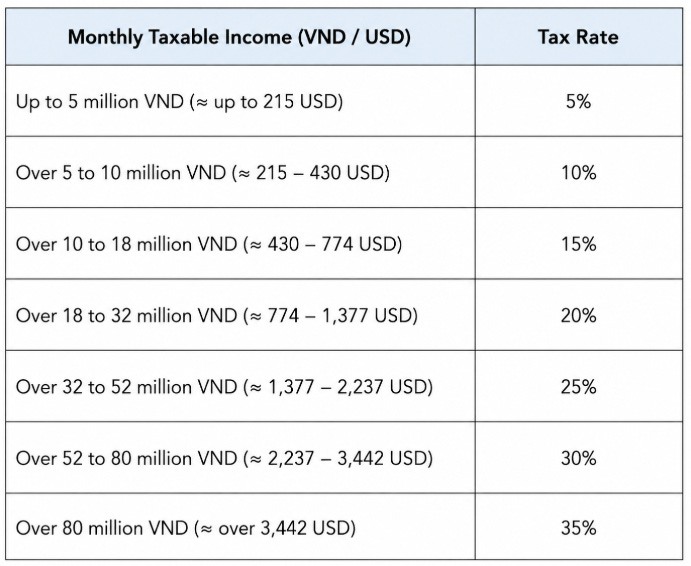
Progressive rates: 0% - 35%
Non-resident
Flat 20% on Vietnam-sourced income
Taxable income
Covers broad categories of income, including:
Salaries and wages
Business income
Capital gains, property, royalties, etc.
For employment income:
Includes salary, allowances, bonuses, benefits
Key deductions
Personal deduction: VND 15.5 million/month
Dependent deduction: VND 6.2 million/month per dependent
Compliance & filing
Employers typically withhold PIT monthly/quarterly
Annual finalisation required:
By employer or individual depending on situation
Deadlines:
~March (employer) / April (individual) after year-end
Practical takeaway: Vietnam PIT is residency-based: residents pay progressive tax (up to 35%) on worldwide income, while non-residents pay a flat 20% on Vietnam-sourced income. The actual tax depends heavily on deductions and proper classification of income/benefits. Employers typically handle withholding, but annual finalisation is still required.
Corporate Income Tax (CIT)
Scope
All enterprises operating in Vietnam (local and foreign)
No tax residency concept for CIT
Companies established in Vietnam are taxed on worldwide income
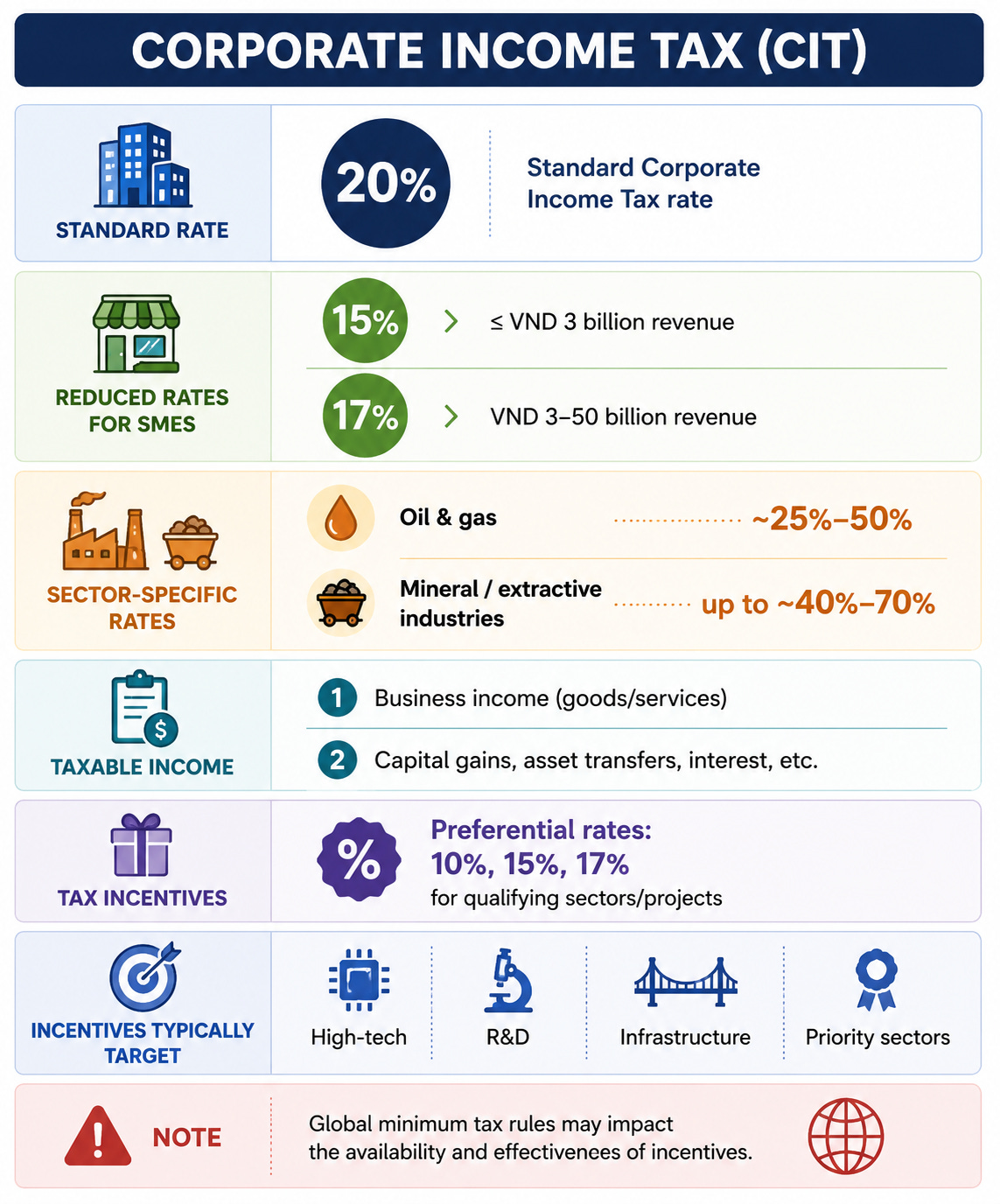
Standard rate: 20%
Reduced rates for SMEs:
15% (≤ VND 3 billion revenue)
17% (VND 3–50 billion revenue)
Sector-specific rates
Oil & gas: ~25%–50%
Mineral / extractive industries: up to ~40%–70%
Taxable income
Business income (goods/services)
Capital gains, asset transfers, interest, etc.
Calculation: Revenue – deductible expenses + other income
Key deductions & losses
Expenses must:
Be business-related
Be properly documented
Loss carryforward:
Up to 5 years
No carryback allowed
Tax incentives
Preferential rates: 10%, 15%, 17% for qualifying sectors/projects
Note: global minimum tax rules may impact this (see below)
Incentives typically target:
High-tech, R&D, infrastructure, priority sectors
May include:
Tax holidays (exemption periods)
Reduced rates for a period
Foreign companies / cross-border
Foreign companies without entity in Vietnam:
Subject to Foreign Contractor Tax (FCT) (see below)
With permanent establishment:
Taxed on Vietnam + related foreign income
Compliance & filing
Quarterly provisional CIT payments required
Annual finalisation:
Due ~3 months after year-end
New development: Global Minimum Tax
Vietnam adopts 15% Global Minimum Tax (from 1 Jan 2024) under OECD rules
Applies to large MNCs (> €750M global revenue)
Mechanism (adopted OECD Pillar Two rules):
Either:
Vietnam collects (QDMTT - “Qualified Domestic Minimum Top-Up Tax“)
OR HQ country collects (IIR - “Income Inclusion Rule“)
Practical takeaway: Vietnam’s CIT is straightforward: most companies pay ~20%, with lower rates or incentives only if specific conditions are met. The real outcome depends on how you structure your presence (local entity vs FCT) and how well expenses are documented. For large MNCs, global minimum tax rules (15%) may limit the benefit of local incentives.
Value-Added Tax (VAT)
Nature
Indirect consumption tax applied on goods & services in Vietnam
Applies to most domestic transactions + imports
Charged at each stage of production/distribution, ultimately borne by final consumer
Scope
Goods & services used for production, trading, consumption in Vietnam
Includes imports + foreign-sourced services
Imports → VAT paid at customs together with import duties
Rates
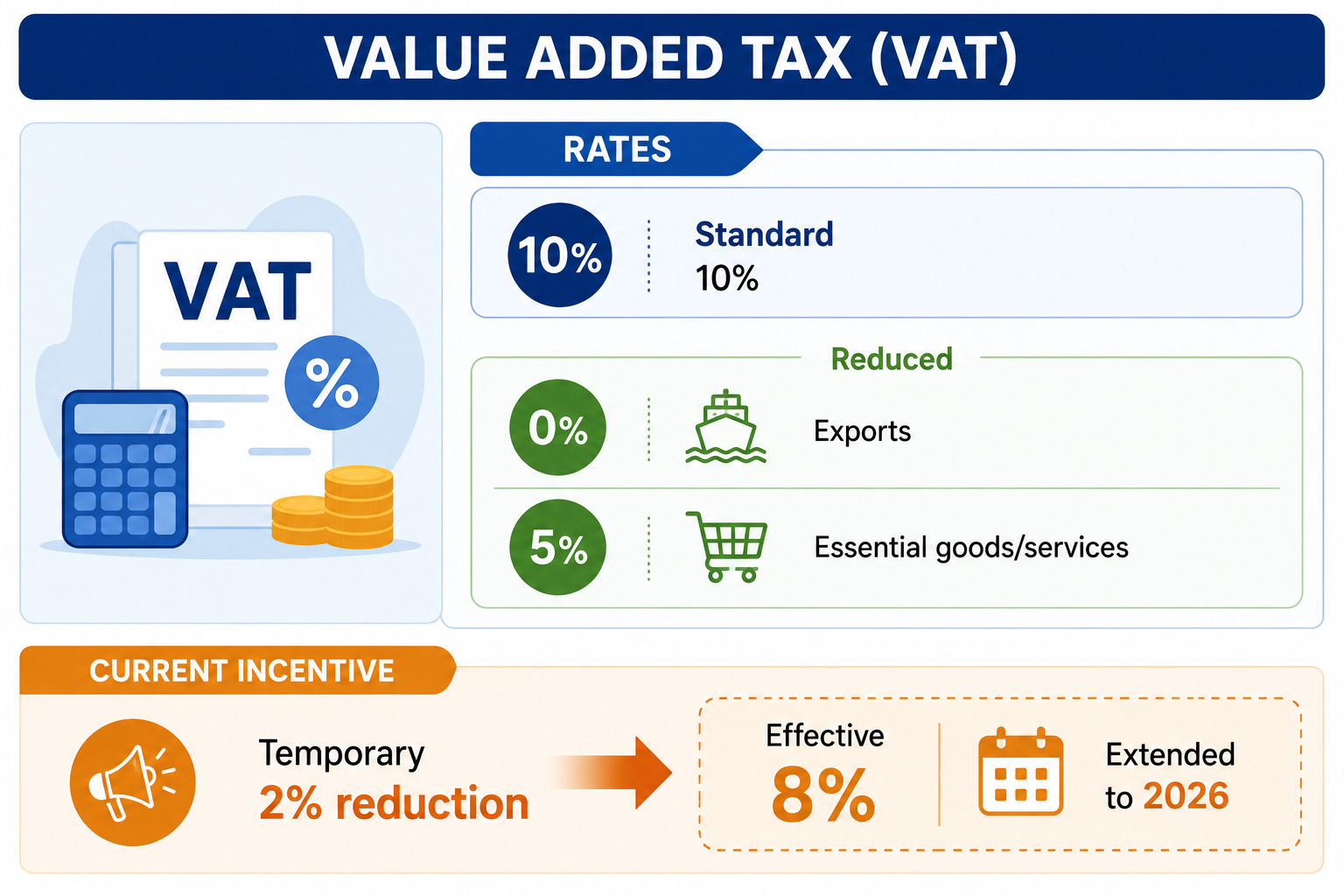
Standard: 10%
Reduced:
0% → exports
5% → essential goods/services
Current incentive:
Temporary 2% reduction → effective 8%, extended to 2026
Calculation methods
Deduction Method (main method)
Formula: VAT payable = Output VAT – Input VAT
Key points: Used by most companies (esp. FIEs)
Requires:
Proper accounting records
Valid VAT invoices
Input VAT credit allowed if compliant
Direct Method
Used for:
Small businesses / individuals
Non-compliant accounting cases
Rates applied on revenue:
Goods trading: 1%
Services: 5%
Production/transport: 3%
Other: 2%
E-commerce/platforms: 10%
Exemptions
Examples:
Financial services
Securities
Insurance (certain)
Land use rights transfer
FX services
No declaration / no payment
Certain agricultural raw products resold
Still can deduct input VAT
Export VAT (0%)
Applies if:
Goods/services consumed outside Vietnam
Proper supporting documents provided
Filing & Payment
Based on turnover:
VND 50B → Monthly filing
≤ VND 50B → Monthly or quarterly
Deadlines:
Monthly → 20th of next month
Quarterly → End of next month after quarter
Refunds
Eligible cases:
Exporters with ≥VND 300M input VAT credits
Investment projects (pre-operation phase)
Businesses mainly taxed at 5%
ODA (Official Development Assistance) / special cases
Key limits:
Export refund capped at 10% of export revenue
Carry forward:
Excess input VAT → carried to next period
E-Invoicing (mandatory)
Required since 1 July 2022
Must register with tax authority before use
Practical takeaway: Vietnam’s VAT system is standard, broad-based, and predictable. It works mainly by offsetting input VAT against output VAT. The temporary reduction from 10% to 8% (to 2026 for certain items) is a key commercial point, while VAT refunds can be meaningful for exporters and investors. Compliance depends heavily on proper invoices, documentation, and choosing the correct method.
3. Special / Industry Taxes
Special Consumption Tax (SCT) - “Sin / Luxury Tax”
Targets:
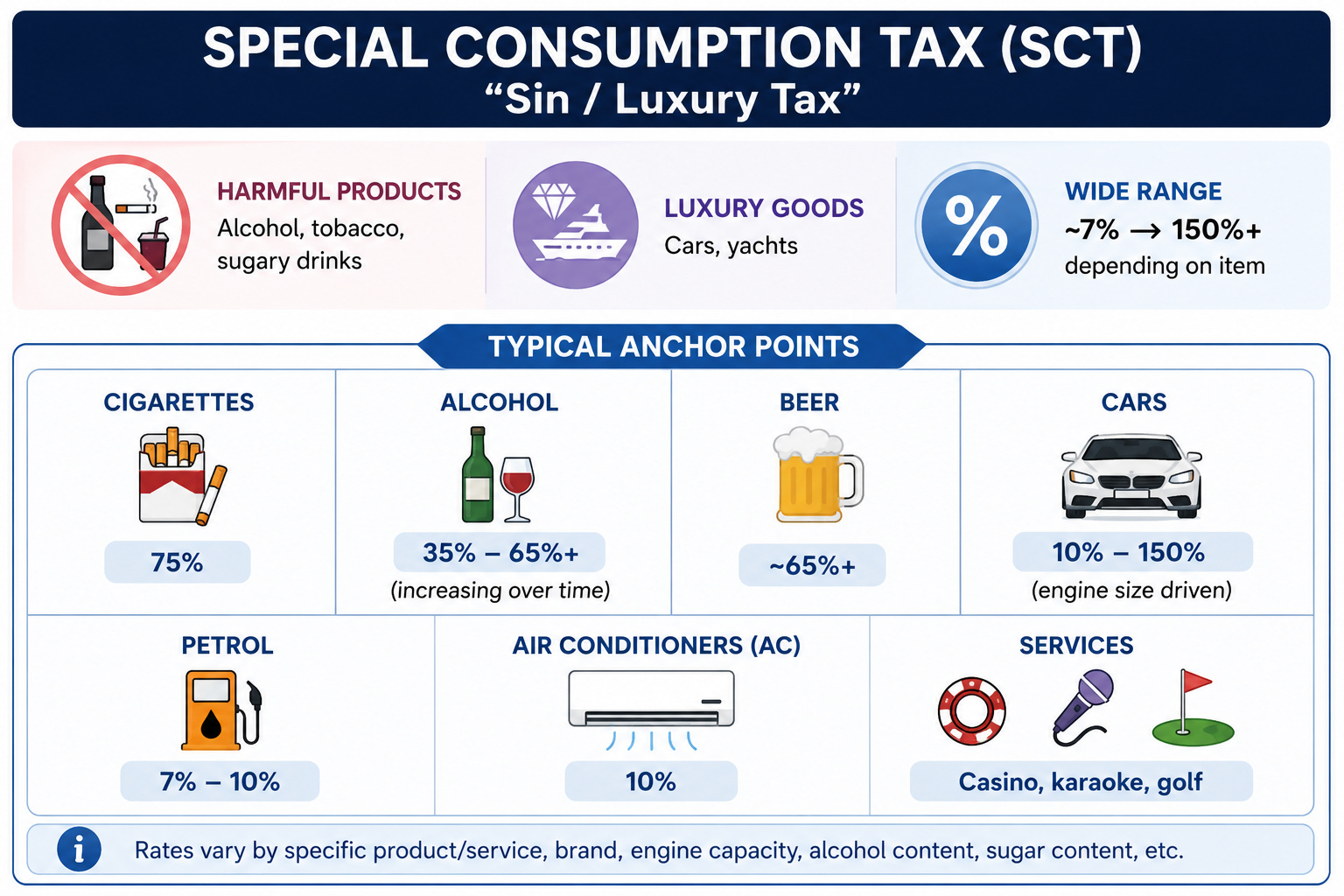
Harmful products (alcohol, tobacco, sugary drinks)
Luxury goods (cars, yachts)
Services (casino, karaoke, golf)
From 2026 onwards — tightening significantly:
Key changes:
Dual structure:
% of price
+ fixed tax per unit (new)
Expansion:
Broader coverage across goods (11 categories) & services (6 categories) - key ones:
Tobacco (cigarettes, cigars)
Alcohol (spirits, wine, beer)
Cars (<24 seats)
Motorbikes (>125cc)
Petrol
Air-conditioners
Luxury items (yachts, airplanes)
Playing cards / votive paper
Nightclubs / discos
Karaoke / massage
Casinos / gaming
Betting
Golf
Lotteries
NEW trend: sugary drinks (from 2027)
Trend:
Rates increasing over time (not one-off)
Alcohol/beer → up to ~90%
Tobacco → rising + per-pack tax
Cars → higher rates for bigger engines
Who pays
Producers
Importers
Service providers
Wide range: ~7% → 150%+ depending on item
Typical anchor points:
Cigarettes: 75%
Alcohol: 35% – 65%+ (increasing over time)
Beer: ~65%+
Cars: 10% – 150% (engine size driven)
Petrol: 7% – 10%
AC: 10%
Offset against double tax:
Raw materials already taxed; and/or
Impact → sell locally
Practical takeaway: 1) SCT rates are high + increasing as general trend; 2) Policy-driven → expect ongoing changes
Foreign Contractor Tax (FCT)
Applies when foreign companies earn Vietnam-related income without a local entity.
Structure:
Combination of:
VAT + income tax (CIT/PIT)
Typical effective rate: ~5–10%
Filing timeline: ~10 days
Very broad scope (no physical presence needed):
Services in Vietnam (consulting, marketing, SaaS, training, etc.)
Services partly performance / linked to Vietnam (installation, maintenance)
Online services (ads, SaaS, training, platforms etc)
Bundled goods + services
Royalties, interest, commissions, licensing
Not applicable:
Pure goods import (no services)
Services fully performed & consumed outside Vietnam
Mechanism:
Vietnamese party withholds tax before payment (within 10 days of payment)
Pays to government on behalf of foreign contractor
Practical takeaway: FCT broadly applies to most cross-border payments from Vietnam (even without a local entity), so always factor ~5–10% tax into pricing upfront. The Vietnamese party must withhold and pay within ~10 days, and poor contract structuring can lead to higher tax exposure.
Import / Export Duties (Customs Tax)
Import tax: varies by product - multiple tax layers (not just tariff)
Import duty
VAT (typically 10%)
SCT (if applicable - e.g. alcohol, cars)
Anti-dumping / safeguard duties (if applicable)
Export tax: limited, many exemptions
Mostly 0% duty
Applies mainly to natural resources (minerals, etc.)
What drives the tax rate
3 key factors:
HS code (classification) → determines base rate
Origin of goods → MFN (standard) vs Preferential (WTO) vs FTA (ASEAN) rates
Type of goods → consumer (higher) vs machinery (lower)
MFN rates (Most Favoured Nation)
Default import tax rate
Applies if:
No special trade agreement applies, or
You can’t prove origin
Usually higher than FTA rates
FTA rates (Free Trade Agreement)
Preferential (lower, sometimes 0%) tax rate
Applies if:
Goods come from an FTA partner country (e.g. China, Korea, EU, ASEAN, CPTPP countries), and
You meet rules of origin + have proper documents (e.g. Certificate of Origin – CO)
Timing
Import: before clearance
Export: within ~30 days
Practical takeaway: Import duties in Vietnam are mainly driven by HS code classification and origin (FTA vs non-FTA), so getting these right upfront is the biggest cost lever. Duties (plus VAT/SCT if applicable) must be paid before clearance, meaning mistakes directly impact cash flow and shipment delays.
4. Other Relevant Taxes
Natural resources tax
Environmental tax
Land use tax (manufacturing, energy, real estate)
5. Business License Tax (BLT)
Nature: annual registration fee ranging from VND 1 million to 3 million based on charter capital or revenue, typically paid at the start of each year
Eliminated from 1 Jan 2026
6. Key Takeaways
System is standard → complexity is in paperwork, not rules
PIT = residency-driven → global vs VN-only tax changes everything
CIT ≈ 20% baseline → incentives exist but not automatic
VAT = input vs output → 8% (temp) is key commercial lever
FCT hits most cross-border flows → assume ~5–10% tax leakage
Customs = HS code + origin → biggest driver of cost (FTA can → 0%)
SCT = high & rising → policy-driven (sin/luxury sectors)
Execution matters most → structure, docs, classification = real outcome